
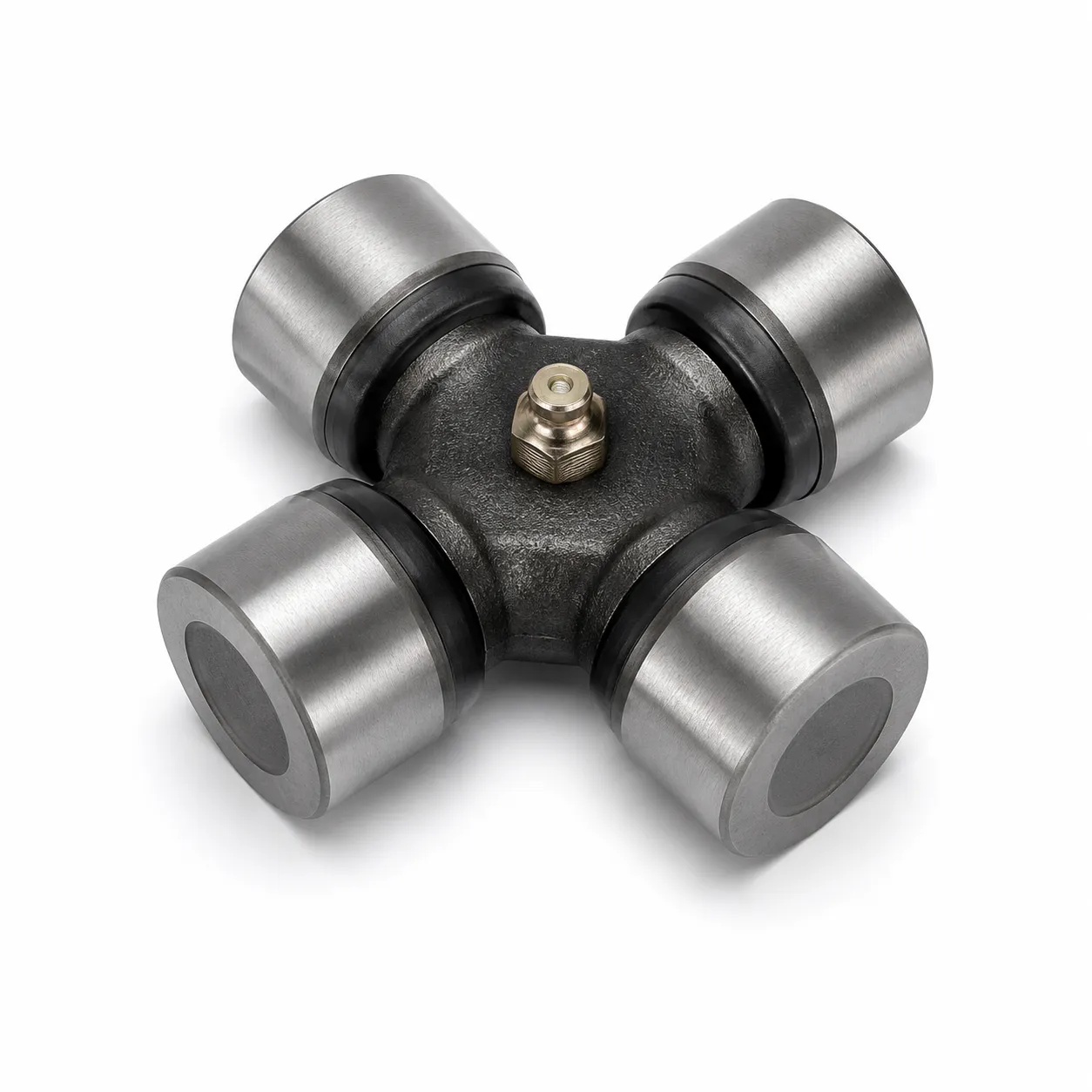
Truck Drive Shaft Universal Joint | Driveshaft U-Joint for Light & Heavy Trucks
As one of the universal joint manufacturers, suppliers, and exporters of mechanical products, We offer universal joint and many other products.
Please get in touch with us for details.
Mail:[email protected]
Manufacturer supplier exporter of the universal joint.
Drive Shaft U-Joint Series Selection Guide by Vehicle Class
The correct drive shaft universal joint for a truck or commercial vehicle is determined by the SAE series specification of the original yoke — not by vehicle brand. The table below matches vehicle class and platform to the correct Jiukai cross-kit series, with cap OD, snap-ring span, and typical Spicer cross-reference for verification.
| Vehicle Class | Typical Models | U-Joint Series | Cap OD | Span | Spicer Ref |
|---|---|---|---|---|---|
| Half-ton light truck / SUV | Ford F-150, Chevy Silverado 1500, Ram 1500, GMC Sierra 1500, Toyota Tundra, Jeep Wrangler JK/JL | 1310 | 27 mm | 74.6 mm | 5-153X |
| Three-quarter-ton truck / full-size van | Ford F-250 base, Chevy Silverado 2500 LD, GMC Sierra 2500, Ram 2500 light, Ford E-350 | 1330 | 30.2 mm | 92 mm | 5-178X |
| One-ton HD pickup — tow package | Ford F-250/F-350 Super Duty, Chevy Silverado 2500HD/3500HD, Ram 2500/3500, GMC Sierra 2500HD/3500HD | 1350 | 35 mm | 106.5 mm | 5-1350X |
| Class 4–5 medium-duty truck | Ford F-450/F-550, Ram 4500/5500, Isuzu NPR/NQR, Mitsubishi Fuso Canter | 1410 | 41 mm | 108 mm | 5-1410X |
| Class 4–6 commercial / bus | Ford F-650/F-750, International 4300, Hino 195/238, transit buses, school buses | 1480 | 41 mm | 118 mm | 5-1480X |
| Class 6–8 heavy truck — linehaul | Peterbilt 389/579, Kenworth T680/W900, Freightliner Cascadia, Volvo VNL, Mack Anthem | 1710 | 48 mm | 127 mm | 5-1710X |
| Class 8 super-heavy / off-highway | Peterbilt 567, Kenworth W990, Freightliner 122SD, Volvo FH16, Caterpillar haul trucks | 1810 | 50 mm | 118 mm | 5-1810X |
Front Drive Shaft vs Rear Drive Shaft Universal Joint
Most truck driveshafts carry two cross kits per shaft: one at each end, connecting the shaft to the transfer case output or differential input. On two-piece driveshafts, a third cross kit connects the front and rear sections at the centre bearing. In a 4WD or AWD truck, the front driveshaft connecting the transfer case to the front differential also carries cross kits, typically one or two depending on whether the shaft has a slip joint.
The front propshaft on most 4WD trucks operates at a higher average angle than the rear, particularly in lifted vehicles. This makes the front driveshaft U-joint more vulnerable to wear acceleration above 10 degrees. When replacing a front drive shaft universal joint, verify the operating angle from the transfer case output to the front axle pinion; angles above 15 degrees at continuous highway speeds will significantly shorten service life regardless of cross-kit quality.
The rear propshaft on a truck typically operates at lower angles but transmits the full engine torque to the driving axle. Under maximum towing loads or during high-torque engine events such as clutch drop starts, the rear cross kits experience the highest torque events in the driveline. Always replace both rear cross kits simultaneously when one shows wear to maintain balanced driveline operation and avoid vibration from mismatched service life between the two joints.
Symptoms of a Bad Universal Joint on a Truck Driveshaft
Recognising a failing driveshaft universal joint early avoids the more expensive repair of a scored yoke bore alongside the cross-kit replacement. The typical symptom progression is:
How to Replace a Universal Joint on a Truck Driveshaft
Replacing a universal joint on a driveshaft requires a hydraulic press for medium-duty and heavy-duty series (1350 and above). Light-truck 1310 and 1330 cross kits can be replaced with a bench vice and appropriately sized sockets, but a press gives more control and reduces the risk of damaging the yoke bore or the new caps during installation.
Before removing the driveshaft, mark the orientation of the shaft to the yoke at both ends with paint or a punch mark. Installing in the same phasing preserves the original driveshaft balance.
Extract the external snap rings with circlip pliers. If the rings are corroded or deformed, use a small flathead screwdriver in the ring gap to break the corrosion seal before applying the pliers.
Support the yoke ear in the press with a socket slightly larger than the cap OD as a receiver. Press the cross until the opposite cap clears the bore, then rotate the assembly and repeat for all four caps.
Measure each yoke bore with a snap gauge. A bore more than 0.05 mm over nominal indicates the yoke should be replaced. Installing a new cross kit in a worn bore results in premature cap rocking and early failure.
Press opposing caps simultaneously to keep the journal centred. Stop pressing as soon as the snap-ring groove clears the bore face. Do not press beyond the groove or the yoke bore will be loaded incorrectly.
Seat all snap rings fully and verify each is flush with the yoke ear face. Reinstall the driveshaft in the marked orientation, torque all fasteners to spec, then grease through the Zerk until fresh grease appears at all four cap seals.
Shop by Series
1310 Series
Half-ton trucks & SUVs | 27×74.6mm
1330 Series
3/4-ton trucks & vans | 30.2×92mm
1350 Series
1-ton HD pickups | 35×106.5mm
1410 Series
Class 4–5 trucks | 41×108mm
1480 Series
Class 4–6 commercial | 41×118mm
1710 Series
Class 6–8 heavy truck | 48×127mm
1810 Series
Class 8 super-heavy | 50×118mm
Driveshaft Universal Joint Maintenance: Greasing Schedule by Truck Class
The most common cause of premature truck universal joint failure is deferred greasing. All Jiukai cross kits in the standard greaseable configuration use a 1/4-28 UNF Zerk fitting compatible with every standard grease gun in workshop use today. The recommended NLGI Grade 2 EP lithium-complex grease should be pumped through the fitting until fresh grease purges at all four cap seals; partial fill is the second leading cause of premature failure after missed intervals. The following schedule is a recommended starting point; adjust downward for vehicles operating at maximum GCW, in water-crossing environments, or at sustained driveshaft angles above 10 degrees.
| Vehicle Class | Series | Normal Highway Interval | Severe Duty Interval |
|---|---|---|---|
| Light truck / SUV | 1310 | 50,000 km / 30,000 mi | 15,000 km / 10,000 mi |
| 3/4-ton truck | 1330 | 40,000 km / 25,000 mi | 15,000 km / 10,000 mi |
| 1-ton HD pickup | 1350 | 40,000 km / 25,000 mi | 20,000 km / 12,000 mi |
| Class 4–5 medium truck | 1410 | 30,000 km / 18,000 mi | 15,000 km / 10,000 mi |
| Class 4–6 commercial | 1480 | 30,000 km / 18,000 mi | 15,000 km / 10,000 mi |
| Class 6–8 heavy truck | 1710 | 50,000 km / 30,000 mi | 25,000 km / 15,000 mi |
| Class 8 / off-highway | 1810 | 50,000 km / 250 hr | 25,000 km / 125 hr |
Frequently Asked Questions
Email your vehicle year, make, model, and driveshaft cap measurements to [email protected] and we will confirm the correct series and a CIF quotation within 24 hours.